

 Please Scroll Down to See Forums Below











You are using an out of date browser. It may not display this or other websites correctly.
You should upgrade or use an alternative browser.
You should upgrade or use an alternative browser.
samoth plz help
- Thread starter Sub-Zero
- Start date
can i get ur work plzmightymouse69 said:


we know you can'tksharp01 said:a who?
lol

ksharp01
New member
i tried solving for F in negative direction going 9.81(Mc+20kg)=F1samoth said:Mass of the cable? Hmm... I don't think I've ever ran into a problem taking into account the cable's mass.
I'd say start with Newton's second law and some force diagrams. Is this a calc problem? Mass of the entire cable, or mass per unit length of the cable?

then i did for for F2-F1=(20+Mc)(v^2/r)
so i did 100N-9.81(Mc+20)=(20+Mc)(8)
i keep getting negative answers,
does that even make sense?
fuck
u sure?mightymouse69 said:mass (m) = 25 kilogram

Raptorex
New member
SublimeZM said:u sure?
bro, you gotta do your work, I've been thru it 3 degrees, if you take the easy way out now, you will be fucked later on...I'm close.
so then would u mind explaining it to me instead of just giving me the answer...mightymouse69 said:bro, you gotta do your work, I've been thru it 3 degrees, if you take the easy way out now, you will be fucked later on...I'm close.
either i fail the homework and dont understand it, or you can help me and i learn it and do well on the homework.
i know its not your job to teach me, but dont give me a dumbass lecture about your degrees and then give me wrong answers to try and fuck me over.
SublimeZM said:so then would u mind explaining it to me instead of just giving me the answer...
either i fail the homework and dont understand it, or you can help me and i learn it and do well on the homework.
i know its not your job to teach me, but dont give me a dumbass lecture about your degrees and then give me wrong answers to try and fuck me over.
Did you take a look at the link I posted for you?
Raptorex
New member
SublimeZM said:so then would u mind explaining it to me instead of just giving me the answer...
either i fail the homework and dont understand it, or you can help me and i learn it and do well on the homework.
i know its not your job to teach me, but dont give me a dumbass lecture about your degrees and then give me wrong answers to try and fuck me over.
I wasn't trying to fuck you over, it was an "educated" guess...see paradox post.
i did, i appreciate it but i know the equations and how to manipulate them as far as that link goesparadox said:Did you take a look at the link I posted for you?
i think it wants me to take into acoun tan equal and opposite force at the connection point of the cable and the weightsamoth said:Well, the distance is actually 1.96m, lol.
I've never done this kind of problem, so I'll have to think about it for a minute.
Raptorex
New member
mightymouse69 said:mass (m) = 25 kilogram
Samoth, please check this answer and get back to Elroy for me.
Raptorex
New member
Example
3. A 20.0 kg mass is pulled by along a surface by a horizontal force of 100 N. Friction is 20.0 N. What is the acceleration of the mass?
Answer to Example 3:
Free body diagram (whenever there are two or more forces):
Sum of forces (vertical forces cancel as evidenced by lack of acceleration in the vertical dimension)
Fnet = T + Ff
Fnet = (100 N) + (-20.0 N) = 80 N
Similar problem here, but solve for mass...
Plus I said DIAGRAM THE FUCKER ALREADY
3. A 20.0 kg mass is pulled by along a surface by a horizontal force of 100 N. Friction is 20.0 N. What is the acceleration of the mass?
Answer to Example 3:
Free body diagram (whenever there are two or more forces):
Sum of forces (vertical forces cancel as evidenced by lack of acceleration in the vertical dimension)
Fnet = T + Ff
Fnet = (100 N) + (-20.0 N) = 80 N
Similar problem here, but solve for mass...
Plus I said DIAGRAM THE FUCKER ALREADY
oh you are just adorableiHulk said:ah, shit, according to your calcualtions the world is gonna end.
oh, nevermind, u forgot to carry the one
all is fine

iHulk
New member
ihulk spelled calculation wrong and you let it go YG.youngguns said:oh you are just adorable
u fucken completely missed the point
lol
mightymouse69 said:Samoth, please check this answer and get back to Elroy for me.
Looks like you're taking F=ma, but dividing the force by the velocity.
iHulk
New member
damm, I'm in AP physics all over again... I actually loved that class.samoth said:Looks like you're taking F=ma, but dividing the force by the velocity.
shit, that sounded nerdy
Raptorex
New member
redguru said:Oh, and MightyMouse is right, vector diagram every friggin problem.
Thanks, doing just the math without actually seeing the problem (via the diagram), will get you every time.
Raptorex
New member
samoth said:I'm stuck thinking there's an angle somewhere. What is this, statics? lol
I did get ~25 by reversing your F1 and F2 in the last equation, but that seems too odd, as taking F=mv would do the same.
as would M= F/A
redguru said:First find acceleration of the block
dv = 4m/sec
dt = 2 sec
a = 2 m/sec^2
F = 100N
F = ma
I thought he had to use (v^2)/r for accel? That would be 8 m/s^2.


redguru
New member
samoth said:I thought he had to use (v^2)/r for accel? That would be 8 m/s^2.
lol
I'm drunk, gimme a break.
moderatersamoth said:Huh? F=mv=ma?
mightymouse69 said:Mass=Force / Acceleration that is all I used...simple.
Yeah, N2L. But total mass is unknown. Acceleration (I'm assuming) needs to be taken via (v^2)/r = 8 m/s^2. How did you calculate the forces?
redguru said:I thought time was given but it was dx
Ooooh, that's why you had dt=2. I was wondering about that, lol.

Subzeero
New member
SublimeZM said:i tried solving for F in negative direction going 9.81(Mc+20kg)=F1
then i did for for F2-F1=(20+Mc)(v^2/r)
so i did 100N-9.81(Mc+20)=(20+Mc)(8)
i keep getting negative answers,
does that even make sense?
fuck
are you sure they are asking for the mass of the rope? Or maybe the tension force in the rope. Do us all a favour and elaborate on what you have done here, and we will come up with a solution.
Define the following in your solution.
r, is this radius? Are you trying to figure the radius of the rope?
also all the units are missing. 9.81 what? N/kg??? Common man!
I also don't know what Mc is. So define that as well please.
And last please state the context of your question. Are you doing simple forces and free body diagrams in two dimensions or something a lot more complex?


beefcake28
New member
samoth said:Ah, (v^2)/2r.
I was thinking that it would make no sense if the rope was significantly heavy(er than the block). I didn't think to look up the accel from velocity independently.
Nice
Slacker...
Subzeero
New member
samoth said:r is actually delta r, the change in distance.
Mc is M sub c, mass of the cable.
9.8 is gravity.
Thanks. This is what i think Sub should do.
Find the total work done by the rope. This is easy.
W = Mass/2(V2(squared)-v1(squared) where initial velocity is zero.
but Total work done equals change in kinetic energy.
W = 1/2 Mass X Velocity(squared), use v2 for velocity.
Solve for mass
(2 X change in kinetic energy)/(V(squared)) = mass.
And thaddaahh... there you have it. I am confident that this is right.
There is so need to involve gravity, its cancelled by normal force.
redguru
New member
samoth said:Okay, I looked up accel/vel in Serway, and (v^2)/r is centripital/tangential velocity, depending on sign.
Stop circling the problem.

redguru
New member
Subzeero said:so what do you think about my solution?
I've already solved it, the proof is about 12 posts below. Yours is elegant, but over the scope of his course work so far.
Subzeero
New member
redguru said:I've already solved it, the proof is about 12 posts below. Yours is elegant, but over the scope of his course work so far.
thank you man.
I read your solution, simple and easy to understand.
I love physics!

mightmouse had the right idea, total mass was 25, then subract the 20 from the block, gives u 5kg for the rope.
i thought it shoulda been something like 100N=m(8)
which gives you 12.5, which was the first thing i tried, but its gotta be multiplied by 2 for some reason???
theres alot more gay ass impossible problems if u guys are enjoying this
i thought it shoulda been something like 100N=m(8)
which gives you 12.5, which was the first thing i tried, but its gotta be multiplied by 2 for some reason???
theres alot more gay ass impossible problems if u guys are enjoying this
i see....samoth said:Ah, (v^2)/2r.
I was thinking that it would make no sense if the rope was significantly heavy(er than the block). I didn't think to look up the accel from velocity independently.
Nice
whys it over 2r? i thought it was just r, thats whats been fucking me over. whys it 2r instead of r?
H
heatherrae
Guest
oh oh oh!!!!
I know!
the answer is:
ELEPHANT!
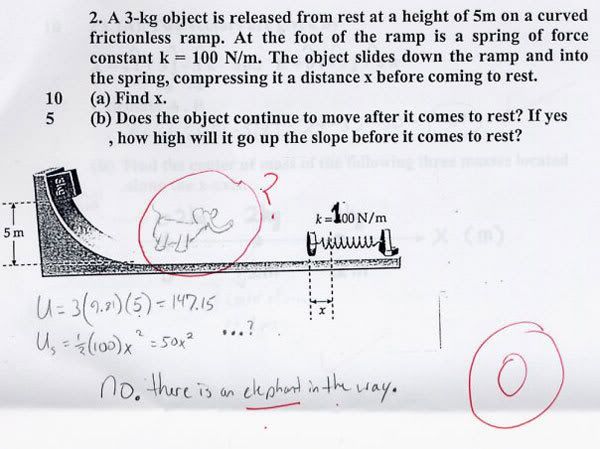
I know!
the answer is:
ELEPHANT!

blut wump
New member
RedGuru has the answer. I was about to post it but clicking on his jpgs pretty much mirrored my own calculations.
5Kg.
The only formulae I bother to remember for this type of problem are:
F = m * a
v = u + a * t
s = (u + 0.5 * a * t) * t - or, equivalently, s = ut + 1/2 a t^2
s = distance, t = time, a = accel., v = velocity, u = initial velocity
With some algebra, other relevant equations can be derived.
5Kg.
The only formulae I bother to remember for this type of problem are:
F = m * a
v = u + a * t
s = (u + 0.5 * a * t) * t - or, equivalently, s = ut + 1/2 a t^2
s = distance, t = time, a = accel., v = velocity, u = initial velocity
With some algebra, other relevant equations can be derived.
Raptorex
New member
Thank you, I will offer you some advice, there is a principal that works over and over, diagram a problem and NEVER make it more complicated than it needs to be, especially in the intro courses.
Good luck!
Good luck!
SublimeZM said:mightmouse had the right idea, total mass was 25, then subract the 20 from the block, gives u 5kg for the rope.
i thought it shoulda been something like 100N=m(8)
which gives you 12.5, which was the first thing i tried, but its gotta be multiplied by 2 for some reason???
theres alot more gay ass impossible problems if u guys are enjoying this


Similar threads

- Replies
- 271
- Views
- 26K


- Replies
- 14
- Views
- 3K


- Replies
- 16
- Views
- 4K


- Replies
- 0
- Views
- 2K