Please Scroll Down to See Forums Below
napsgear
genezapharmateuticals
domestic-supply puritysourcelabs US-PHARMACIES
UGL OZ Raptor Labs UGFREAK
napsgeargenezapharmateuticals domestic-supplypuritysourcelabsUGL OZUGFREAKUS-PHARMACIESRaptor Labs

..he forgot Poland! What about Poland?.....

WODIN

बुद्धकर&
Platinum
Poland to Pull Troops from Iraq at End of Year

WARSAW (Reuters) - Poland's government decided on Tuesday to withdraw its troops from Iraq at the end of 2005, making official an earlier proposal, Defense Minister Jerzy Szmajdzinski said.


"At the time of the expiry of the Security Council's mandate -- meaning at the end of 2005 -- the operations of the Polish stabilization mission should be finished," Szmajdzinski told a news conference after a cabinet meeting.

Poland, a close ally of Washington in Europe and one of the few supporters of its war to topple Saddam Hussein in 2003, has about 1,700 soldiers in south-central Iraq, where it runs a multi-national stabilization force.

Szmajdzinski said Prime Minister Marek Belka's government, which opinion polls show losing power in elections due by October, would not commit Polish troops to any other missions.

"Belka's government will surely not make any new military commitments. We are carrying out an exit strategy from Iraq."

Despite popular opposition at home to Poland's military engagement in Iraq, where 17 Polish soldiers have been killed, all mainstream parties have remained committed to finishing the stabilization mission in the Gulf state.
 
Cool, thats when we'll be bringing home most of our soldiers as well, since the Iraqis are increasingly able to take over responsibility for their own defense.

That actually deserves its own thread, since it so the evenetuality so completely demolishes the last objection of the left.

Time to make up new excuses to justify your error and your support of a brutal dictator
 
Fourteen permanent US Bases are being built. Keep dreeping dumbass.
 
WODIN said:
Fourteen permanent US Bases are being built. Keep dreeping dumbass.


What in that statement contradicts what I wrote genius?

:lmao:
 
jerseyart said:
What in that statement contradicts what I wrote genius?

:lmao:
Uhm...whos going to man those 14 bases? Faries or morons like you from Jersey?
 
WODIN said:
Uhm...whos going to man those 14 bases? Faries or morons like you from Jersey?


All the faeries and morons are democrats, and the military is overwhelmingly republican, so that can't be right

What I wrote was

"Cool, thats when we'll be bringing home most of our soldiers as well, since the Iraqis are increasingly able to take over responsibility for their own defense."


So once again Mr. "I never got hooked on phonics", what part of my statement contradicts anything in your own.

I bet you still don't get it even after I've given you all the clues you need to draw the correct conclusion.
 
"some ,all ,most "who fucking cares.Anyone with half a brain knows they shouldnt have gone in the first place.Now we have 14 military bases to fill there.Even though that would be the last thing A free Democratic Iraq would need or want.
 
CFZB said:
"some ,all ,most "who fucking cares.Anyone with half a brain knows they shouldnt have gone in the first place.Now we have 14 military bases to fill there.Even though that would be the last thing A free Democratic Iraq would need or want.


Eveeryone with half a brain or less did oppose the war, so you are right in that respect.

But nah, I imagine the Iraqis wont mind a US military presence to deter Iranian and Syrian aggression in the interim
 
jerseyart said:
Eveeryone with half a brain or less did oppose the war, so you are right in that respect.

But nah, I imagine the Iraqis wont mind a US military presence to deter Iranian and Syrian aggression in the interim
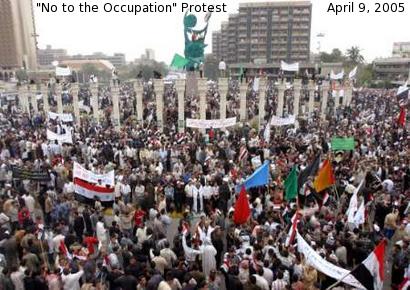
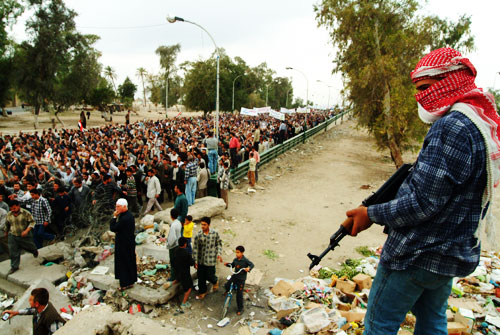
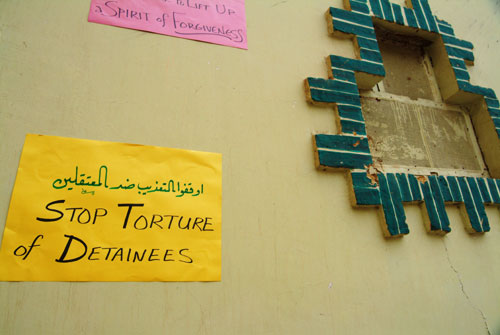
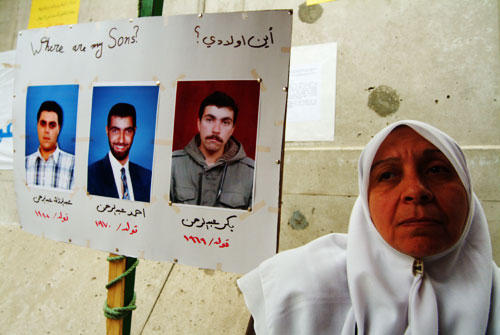
do you realy need me to show you pictures of the protests?

and link the articles?
 
CFZB said:

They're stupid commie, liberal atheists too. Anyone that is not a hardcore neo-conservative Bush supporter with good Catholic views is a moronic, commie, liberal athiest.
 
_41016591_protest_getty203body.jpg


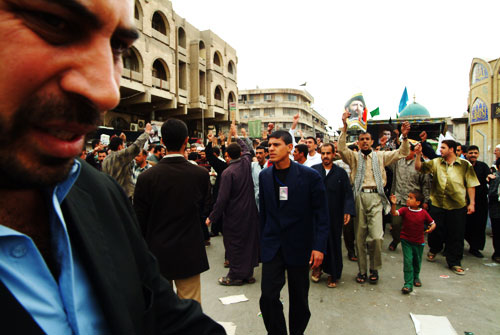
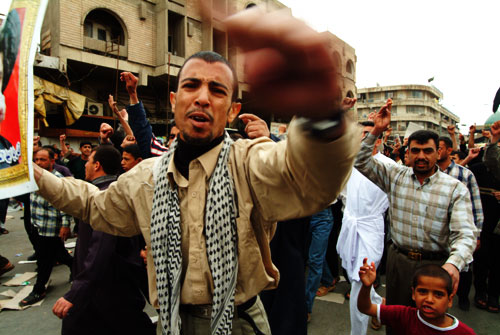
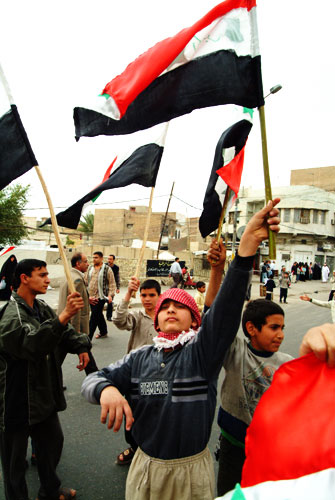
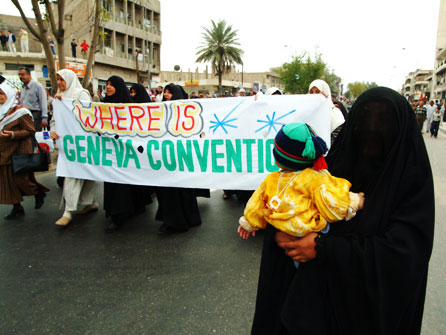
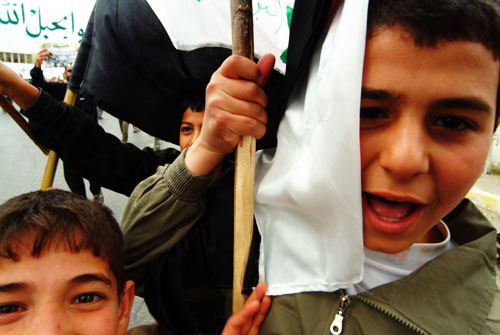
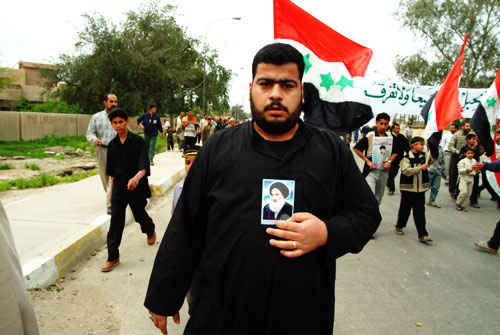
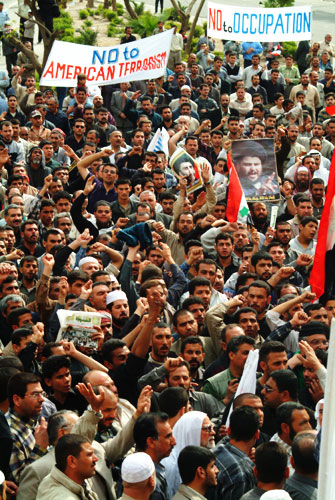
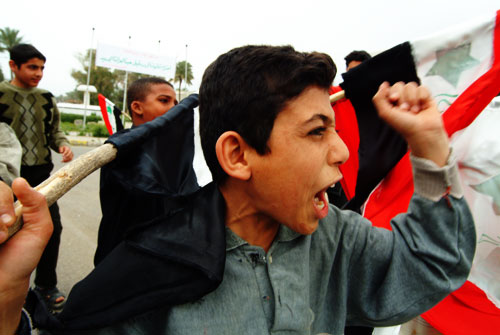
Tens of thousands of protesters have marched through Baghdad denouncing the US occupation of Iraq, two years after the fall of Saddam Hussein.

http://news.bbc.co.uk/2/hi/middle_east/4429137.stm
 
CFZB said:
do you realy need me to show you pictures of the protests?

and link the articles?
'

LOL

To prove what bor? Im more curious as to how your mind connects those dots than the actual protests.
 
jerseyart said:
'

LOL

To prove what bor? Im more curious as to how your mind connects those dots than the actual protests.
to the fact that they want us to leave and we never should have gone?
 
CFZB said:
to the fact that they want us to leave and we never should have gone?


Ok so absent 100% support your reasoning concludes we should never have gone. Does that just apply to Iraq, or is that how you make all your determinations on foreign policy?

And if its less than 100%, then how much less?

Like, if five guys started marching down the street would it be your determination that we should abanadon Iraq?

Im sincerely curious. I mean, theres 20 million + Iraqis, so how many would it actually take?

More than that marched against the global economic system, should we abandon that as well. If I can get 50k to march against the democratic party, can we ask to disband them as well

:lmao:


Bor

Twenty million + people are now free to determine their own future. Even though you hate Bush, thats actually a good thing.

Because of this Egypt hasd now been pressured to hold free elections. This is a good thing.

Syria is withdrawing troops from Lebanaon, opening the possibility of genuine elections there as well. This is a good thing

Libya has handed over its WMD program, complete with nuclear technologies. This is a good thing.

They're all good good things, regardless of whether you hate the author of that outcome.

Even the leftist French and German newspapers are starting to editorialiaze that "maybe Bush was right" Its ok bor to admit error

Even Bill Mahr is doing it . LOL
 
CFZB said:
so why arent you doing it?


You guys claimed the entire country would fight like crazy to throw us out

Never happened

You said we would lose 10k men taking Baghdad alone

Never happened

You claimed the whole region would take up arms and rebel

Never happened

You said the elections would never happen

They did

You claimed the country would fracture apart

It hasnt, just the opposite


I could go on and on and on

You've been wrong about everything.

You'll attempt to point out the WMD's, but the argument is still the same. We have never even accounted for (nor has he) for the WMD's he acknowledged himself as possessing. The ceasefire made it incumbent on him to prove he had ended those programs (which we now know he never did) and to the contrary, he obstructed at every turn.

You guys supported a murderous horrific regime which was enslaving tens of millions in its tyranny because you hate Bush

Please

Ill take my position over yours any day of the week

Bush is changing the paradigm of the Mid East. In less than 2 short years we have democracy taking root not only in Iraq, but in the region as well, where it has never existed.

Your policies would have left them in perpetual servitude to dictators and petty tyrants, and for that you should be ashamed
 
you guys supported a horrific regime?

You're boy Reagan armed the fucker to the teeth. Go dumb fuck.
 
"We need a common enemy to unite us. "

"We don't want the smoking gun to be a mushroom cloud. "


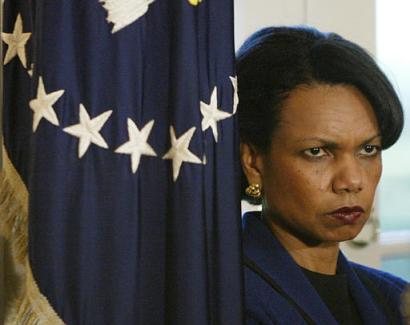
rice.jpg
 
WODIN said:
you guys supported a horrific regime?

You're boy Reagan armed the fucker to the teeth. Go dumb fuck.


You dont even know your history bor, which is why all you write is so confused.

Let me educate you.

Reagan only began support of Iraq after Iran rejected the UN sponsored peace accord. They also made it clear at that time that they planned on moving past a takeover of Iraq, to claim SA and Kuwait at minimum as well.

It was at that point we "helped" Iraq. Out help consisted primnarily of not objecting to France and Germany (beginning to see a pattern) selling the some 30-40 billion in arms to fight Iran. Our total aid amounted to roughly 1.5 billion (just for comparison purposes) and was largely providing the Iraqis satellite photos of troop movements.


Again, nothing about liberalism that knowledge cant cure
 
The Ties That Blind
How Reagan Armed Saddam with Chemical Weapons
By NORM DIXON

On August 18, 2002, the New York Times carried a front-page story headlined, "Officers say U.S. aided Iraq despite the use of gas". Quoting anonymous US "senior military officers", the NYT "revealed" that in the 1980s, the administration of US President Ronald Reagan covertly provided "critical battle planning assistance at a time when American intelligence knew that Iraqi commanders would employ chemical weapons in waging the decisive battles of the Iran-Iraq war". The story made a brief splash in the international media, then died.

While the August 18 NYT article added new details about the extent of US military collaboration with Iraqi dictator Saddam Hussein during Iraq's 1980-88 war with Iran, it omitted the most outrageous aspect of the scandal: not only did Ronald Reagan's Washington turn a blind-eye to the Hussein regime's repeated use of chemical weapons against Iranian soldiers and Iraq's Kurdish minority, but the US helped Iraq develop its chemical, biological and nuclear weapons programs.

Nor did the NYT dwell on the extreme cynicism and hypocrisy of President George Bush II's administration's citing of those same terrible atrocities--which were disregarded at the time by Washington--and those same weapons programs--which no longer exist, having been dismantled and destroyed in the decade following the 1991 Gulf War--to justify a massive new war against the people of Iraq.

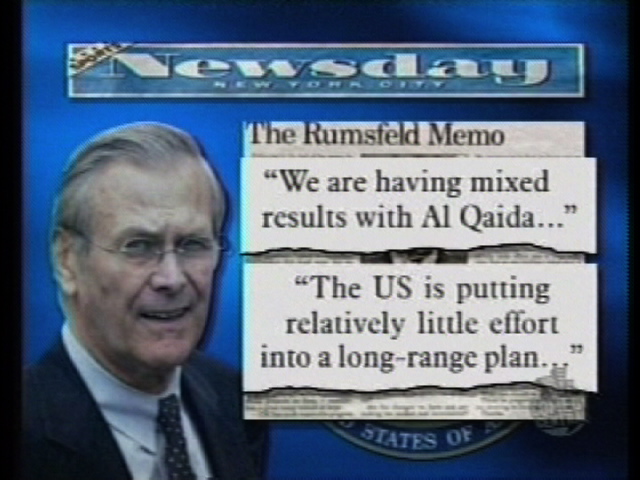
A reader of the NYT article (or the tens of thousands of other articles written after the war drive against Iraq began in earnest soon after September 11, 2001) would have looked in vain for the fact that many of the US politicians and ruling class pundits who demanded war against Hussein--in particular, the one of the most bellicose of the Bush administration's "hawks", defence secretary Donald Rumsfeld--were up to their ears in Washington's efforts to cultivate, promote and excuse Hussein in the past.

The NYT article read as though Washington's casual disregard about the use of chemical weapons by Hussein's dictatorship throughout the 1980s had never been reported before. However, it was not the first time that "Iraqgate"--as the scandal of US military and political support for Hussein in the '80s has been dubbed--has raised its embarrassing head in the corporate media, only to be quickly buried again.

One of the more comprehensive and damning accounts of Iraqgate was written by Douglas Frantz and Murray Waas and published in the February 23, 1992, Los Angeles Times. Headlined, "Bush secret effort helped Iraq build its war machine", the article reported that "classified documents obtained by the LA Times show ... a long-secret pattern of personal efforts by [George Bush senior]--both as president and vice president--to support and placate the Iraqi dictator."

Even William Safire, the right-wing, war-mongering NYT columnist, on December 7, 1992, felt compelled to write that, "Iraqgate is uniquely horrendous: a scandal about the systematic abuse of power by misguided leaders of three democratic nations [the US, Britain and Italy] to secretly finance the arms buildup of a dictator".

The background to Iraqgate was the January 1979 popular uprising that overthrew the cravenly pro-US Shah of Iran. The Iranian revolution threatened US imperialism's domination of the strategic oil-rich region. Other than Israel, Iran had long been Washington's key ally in the Middle East.

Washington immediately began to "cast about for ways to undermine or overthrow the Iranian revolution, or make up for the loss of the Shah. Hussein's regime put up its hand. On September 22, 1980, Iraq launched an invasion of Iran. Throughout the bloody eight-year-long war--which cost at least 1 million lives--Washington backed Iraq.

As a 1990 report prepared for the Pentagon by the Strategic Studies Institute of the US War College admitted: "Throughout the [Iran-Iraq] war the United States practised a fairly benign policy toward Iraq... [Washington and Baghdad] wanted to restore the status quo ante ... that prevailed before [the 1979 Iranian revolution] began threatening the regional balance of power. Khomeini's revolutionary appeal was anathema to both Baghdad and Washington; hence they wanted to get rid of him. United by a common interest ... the [US] began to actively assist Iraq."

At first, as Iraqi forces seemed headed for victory over Iran, official US policy was neutrality in the conflict. Not only was Hussein doing Washington's dirty work in the war with Iran, but the US rulers believed that Iraq could be lured away from its close economic and military relationship with the Soviet Union--just as Egypt's President Anwar Sadat had done in the 1970s.

In March 1981, US Secretary of State Alexander Haig excitedly told the Senate foreign relations committee that Iraq was concerned by "the behaviour of Soviet imperialism in the Middle Eastern region". The Soviet government had refused to deliver arms to Iraq as long as Baghdad continued its military offensive against Iran. Moscow was also unhappy with the Hussein's vicious repression of the Iraqi Communist Party.

Washington's support (innocuously referred to as a "tilt" at the time) for Iraq became more open after Iran succeeded in driving Iraqi forces from its territory in May 1982; in June, Iran went on the offensive against Iraq. The US scrambled to stem Iraq's military setbacks. Washington and its conservative Arab allies suddenly feared Iran might even defeat Iraq, or at least cause the collapse of Hussein's regime.

Using its allies in the Middle East, Washington funnelled huge supplies of arms to Iraq. Classified State Department cables uncovered by Frantz and Waas described covert transfers of howitzers, helicopters, bombs and other weapons to Baghdad in 1982-83 from Egypt, Saudi Arabia, Jordan and Kuwait.

Howard Teicher, who monitored Middle East policy at the US National Security Council during the Reagan administration, told the February 23, 1992, LA Times: "There was a conscious effort to encourage third countries to ship US arms or acquiesce in shipments after the fact. It was a policy of nods and winks."

According to Mark Phythian's 1997 book Arming Iraq: How the US and Britain Secretly Built Saddam's War Machine (Northeastern University Press), in 1983 Reagan asked Italy's Prime Minister Guilo Andreotti to channel arms to Iraq.

The January 1, 1984 Washington Post reported that the US had "informed friendly Persian Gulf nations that the defeat of Iraq in the three-year-old war with Iran would be 'contrary to US interests' and has made several moves to prevent that result".

Central to these "moves" was the cementing of a military and political alliance with Saddam Hussein's repressive regime, so as to build up Iraq as a military counterweight to Iran. In 1982, the Reagan administration removed Iraq from the State Department's list of countries that allegedly supported terrorism. On December 19-20, 1983, Reagan dispatched his Middle East envoy--none other than Donald Rumsfeld--to Baghdad with a hand-written offer of a resumption of diplomatic relations, which had been severed during the 1967 Arab-Israel war. On March 24, 1984, Rumsfeld was again in Baghdad.

On that same day, the UPI wire service reported from the UN: "Mustard gas laced with a nerve agent has been used on Iranian soldiers ... a team of UN experts has concluded ... Meanwhile, in the Iraqi capital of Baghdad, US presidential envoy Donald Rumsfeld held talks with foreign minister Tariq Aziz."

The day before, Iran had accused Iraq of poisoning 600 of its soldiers with mustard gas and Tabun nerve gas.

There is no doubt that the US government knew Iraq was using chemical weapons. On March 5, 1984, the State Department had stated that "available evidence indicates that Iraq has used lethal chemical weapons". The March 30, 1984, NYT reported that US intelligence officials has "what they believe to be incontrovertible evidence that Iraq has used nerve gas in its war with Iran and has almost finished extensive sites for mass producing the lethal chemical warfare agent".

However, consistent with the pattern throughout the Iran-Iraq war and after, the use of these internationally outlawed weapons was not considered important enough by Rumsfeld and his political superiors to halt Washington's blossoming love affair with Hussein.

The March 29, 1984, NYT, reporting on the aftermath of Rumsfeld's talks in Baghdad, stated that US officials had pronounced "themselves satisfied with relations between Iraq and the US and suggest that normal diplomatic ties have been restored in all but name". In November 1984, the US and Iraq officially restored diplomatic relations.

According to Washington Post journalist Bob Woodward, in a December 15, 1986 article, the CIA began to secretly supply Iraq with intelligence in 1984 that was used to "calibrate" mustard gas attacks on Iranian troops. Beginning in early 1985, the CIA provided Iraq with "data from sensitive US satellite reconnaissance photography ... to assist Iraqi bombing raids".

Iraqi chemical attacks on Iranian troops--and US assistance to Iraq--continued throughout the Iran-Iraq war. In a parallel program, the US defence department also provided intelligence and battle-planning assistance to Iraq.

The August 17, 2002 NYT reported that, according to "senior military officers with direct knowledge of the program", even though "senior officials of the Reagan administration publicly condemned Iraq's employment of mustard gas, sarin, VX and other poisonous agents ... President Reagan, vice president George Bush [senior] and senior national security aides never withdrew their support for the highly classified program in which more than 60 officers of the Defense Intelligence Agency (DIA) were secretly providing detailed information on Iranian deployments, tactical planning for battles, plans for air strikes and bomb-damage assessments for Iraq."

Retired DIA officer Rick Francona told the NYT that Iraq's chemical weapons were used in the war's final battle in early 1988, in which Iraqi forces retook the Fao Peninsula from the Iranian army.

Another retired DIA officer, Walter Lang, told the NYT that "the use of gas on the battlefield by the Iraqis was not a matter of deep strategic concern". What concerned the DIA, CIA and the Reagan administration was that Iran not break through the Fao Peninsula and spread the Islamic revolution to Kuwait and Saudi Arabia.

Iraq's 1982 removal from Washington's official list of states that support terrorism meant that the Hussein regime was now eligible for US economic and military aid, and was able to purchase advanced US technology that could also be used for military purposes.

Conventional military sales resumed in December 1982. In 1983, the Reagan administration approved the sale of 60 Hughes helicopters to Iraq in 1983 "for civilian use". However, as Phythian pointed out, these aircraft could be "weaponised" within hours of delivery. Then US Secretary of State George Schultz and commerce secretary George Baldridge also lobbied for the delivery of Bell helicopters equipped for "crop spraying". It is believed that US-supplied choppers were used in the 1988 chemical attack on the Kurdish village of Halabja, which killed 5000 people.

With the Reagan administration's connivance, Baghdad immediately embarked on a massive militarisation drive. This US-endorsed military spending spree began even before Iraq was delisted as a terrorist state, when the US commerce department approved the sale of Italian gas turbine engines for Iraq's naval frigates.

Soon after, the US agriculture department's Commodity Credit Corporation (CCC) guaranteed to repay loans--in the event of defaults by Baghdad--banks had made to Iraq to buy US-grown commodities such as wheat and rice. Under this scheme, Iraq had three years to repay the loans, and if it could not the US taxpayers would have to cough up.

Washington offered this aid initially to prevent Hussein's overthrow as the Iraqi people began to complain about the food shortages caused by the massive diversion of hard currency for the purchase of weapons and ammunition. The loan guarantees amounted to a massive US subsidy that allowed Hussein to launch his overt and covert arms buildup, one result being that the Iran-Iraq war entered a bloody five-year stalemate.

By the end of 1983, US$402 million in agriculture department loan guarantees for Iraq were approved. In 1984, this increased to $503 million and reached $1.1 billion in 1988. Between 1983 and 1990, CCC loan guarantees freed up more than $5 billion. Some $2 billion in bad loans, plus interest, ended up having to be covered by US taxpayers.

A similar taxpayer-funded, though smaller scale, scam operated under the auspices of the federal Export-Import Bank. In 1984, vice-president George Bush senior personally intervened to ensure that the bank guaranteed loans to Iraq of $500 million to build an oil pipeline. Export-Import Bank loan guarantees grew from $35 million in 1985 to $267 million by 1990.

According to William Blum, writing in the August 1998 issue of the Progressive, Sam Gejdenson, chairperson of a Congressional subcommittee investigating US exports to Iraq, disclosed that from 1985 until 1990 "the US government approved 771 licenses [only 39 were rejected] for the export to Iraq of $1.5 billion worth of biological agents and high-tech equipment with military application ...

"The US spent virtually an entire decade making sure that Saddam Hussein had almost whatever he wanted... US export control policy was directed by US foreign policy as formulated by the State Department, and it was US foreign policy to assist the regime of Saddam Hussein."

A 1994 US Senate report revealed that US companies were licenced by the commerce department to export a "witch's brew" of biological and chemical materials, including bacillus anthracis (which causes anthrax) and clostridium botulinum (the source of botulism). The American Type Culture Collection made 70 shipments of the anthrax bug and other pathogenic agents.

The report also noted that US exports to Iraq included the precursors to chemical warfare agents, plans for chemical and biological warfare facilities and chemical warhead filling equipment. US firms supplied advanced and specialised computers, lasers, testing and analysing equipment. Among the better-known companies were Hewlett Packard, Unisys, Data General and Honeywell.

Billions of dollars worth of raw materials, machinery and equipment, missile technology and other "dual-use" items were also supplied by West German, French, Italian, British, Swiss and Austrian corporations, with the approval of their governments (German firms even sold Iraq entire factories capable of mass-producing poison gas). Much of this was purchased with funds freed by the US CCC credits.

The destination of much of this equipment was Saad 16, near Mosul in northern Iraq. Western intelligence agencies had long known that the sprawling complex was Iraq's main ballistic missile development centre.

Blum reported that Washington was fully aware of the likely use of this material. In 1992, a US Senate committee learned that the commerce department had deleted references to military end-use from information it sent to Congress about 68 export licences, worth more than $1 billion.

In 1986, the US defence department's deputy undersecretary for trade security, Stephen Bryen, had objected to the export of an advanced computer, similar to those used in the US missile program, to Saad 16 because "of the high likelihood of military end use". The state and commerce departments approved the sale without conditions.

In his book, The Death Lobby: How the West Armed Iraq, Kenneth Timmerman points out that several US agencies were supposed to review US exports that may be detrimental to US "national security". However, the commerce department often did not submit exports to Hussein's Iraq for review or approved them despite objections from other government departments.

On March 16, 1988, Iraqi forces launched a poison gas attack on the Iraqi Kurdish village of Halabja, killing 5000 people. While that attack is today being touted by senior US officials as one of the main reasons why Hussein must now be "taken out", at the time Washington's response to the atrocity was much more relaxed.

Just four months later, Washington stood by as the US giant Bechtel corporation won the contract to build a huge petrochemical plant that would give the Hussein regime the capacity to generate chemical weapons.

On September 8, 1988, the US Senate passed the Prevention of Genocide Act, which would have imposed sanctions on the Hussein regime. Immediately, the Reagan administration announced its opposition to the bill, calling it "premature". The White House used its influence to stall the bill in the House of Representatives. When Congress did eventually pass the bill, the White House did not implement it.

Washington's political, military and economic sweetheart deals with the Iraqi dictator came under even more stress when, in August 1989, FBI agents raided the Atlanta branch of the Rome-based Banca Nazionale del Lavoro (BNL) and uncovered massive fraud involving the CCC loan guarantee scheme and billions of dollars worth of unauthorised "off-the-books" loans to Iraq.

BNL Atlanta manager Chris Drougal had used the CCC program to underwrite programs that had nothing to do with agricultural exports. Using this covert set-up, Hussein's regime tried to buy the most hard-to-get components for its nuclear weapons and missile programs on the black market.

Russ Baker, writing in the March/April 1993 Columbia Journalism Review, noted: "Elements of the US government almost certainly knew that Drougal was funnelling US-backed loans--into dual-use technology and outright military technology. The British government was fully aware of the operations of Matrix-Churchill, a British firm with an Ohio branch, which was not only at the centre of the Iraqi procurement network but was also funded by BNL Atlanta... It would be later alleged by bank executives that the Italian government, long a close US ally as well as BNL's ultimate owner, had knowledge of BNL's loan diversions."

Yet, even the public outrage generated by the Halabja massacre and the widening BNL scandal did not cool Washington's ardour towards Hussein's Iraq.

On October 2, 1989, US President George Bush senior signed the top-secret National Security Decision 26, which declared: "Normal relations between the US and Iraq would serve our long-term interests and promote stability in both the Gulf and the Middle East. The US should propose economic and political incentives for Iraq to moderate its behaviour and increase our influence with Iraq... We should pursue, and seek to facilitate, opportunities for US firms to participate in the reconstruction of the Iraqi economy."

As public and congressional pressure mounted on the US Agriculture Department to end Iraq's access to CCC loan guarantees, Secretary of State James Baker--armed with NSD 26--personally insisted that agriculture secretary Clayton Yeutter drop his opposition to their continuation.

In November 1989, Bush senior approved $1 billion in loan guarantees for Iraq in 1990. In April 1990, more revelations about the BNL scandal had again pushed the department of agriculture to the verge of halting Iraq's CCC loan guarantees. On May 18, national security adviser Scowcroft personally intervened to ensure the delivery of the first $500 million tranche of the CCC subsidy for 1990.

According to Frantz and Waas' February 23, 1992, LA Times article, in July 1990 "officials at the National Security Council and the State Department were pushing to deliver the second installment of the $1 billion in loan guarantees, despite the looming crisis in the region and evidence that Iraq had used the aid illegally to help finance a secret arms procurement network to obtain technology for its nuclear weapons and ballistic-missile program".

From July 18 to August 1, 1990, Bush senior's administration approved $4.8 million in advanced technology sales to Iraq. The end-users included Saad 16 and the Iraqi ministry of industry and military industrialisation. On August 1, $695,000 worth of advanced data transmission devices were approved.

"Only on August 2, 1990, did the agriculture department officially suspend the [CCC loan] guarantees to Iraq--the same day that Hussein's tanks and troops swept into Kuwait", noted Frantz and Waas.
 
Rumsfeld's Account Book
Who Armed Saddam?


You have to give Defense Secretary Rumsfeld some of this credit: he's a risk taker, and he's damned brassy about it.

Both were in evidence last week when he testified before the Senate Armed Services Committee. Under criticism for his prior characterizations of France and Germany as "old Europe," Rumsfeld fumed: "We would not be facing the problems in Iraq today if the technologically advanced countries of the world had seen the danger and strictly enforced the economic sanctions against Iraq."

The Defense Secretary knew well, naturally, his audience in the Senate Armed Services Committee. As Senator Robert Byrd recently said from the Senate floor, ...."this Chamber is, for the most part, silent--ominously, dreadfully silent. There is no debate, no discussion, no attempt to lay out for the nation the pros and cons of this particular war. There is nothing."

Still, Rumsfeld's statement was some chutspa! He was well aware that it was the U.S. Senate itself (Committee on Banking, Housing and Urban Affairs) which had conducted extensive hearings in 1992 and 1994 on "United States Dual-Use Exports to Iraq and Their Impact on the Health of Persian Gulf War Veterans." And he'd probably read the front page Washington Post story ("U.S. Had Key Role in Iraq Buildup", 12/30/02) based upon recently declassified documents, which revealed that it was Rumsfeld himself who, as President Reagan's Middle East Envoy, had traveled to the Region to meet with Saddam Hussein in December 1983 to normalize, particularly, security relations.

At the time of the visit , Iraq had already been removed from the State Department's list of terrorist countries in 1982; and in the previous month, November, President Reagan had approved National Security Decision Directive 114, on expansion of U.S.-Iraq relations generally. But it was Donald Rumsfeld's trip to Baghdad which opened of the floodgates during 1985-90 for lucrative U.S. weapons exports--some $1.5 billion worth-- including chemical/biological and nuclear weapons equipment and technology, along with critical components for missile delivery systems for all of the above. According to a 1994 GAO Letter Report (GAO/NSIAD-94-98) some 771 weapons export licenses for Iraq were approved during this six year period....not by our European allies, but by the U.S. Department of Commerce.

To be sure, many of these weapons were expended in the latter phases of the Iran-Iraq war. Others were destroyed by Coalition forces in the Persian Gulf War, or by UN weapons inspectors in the control regime established by the UN Security Council following that conflict. But a great many undoubtedly remain, and pose grave risks to the 150,000 U.S. troops deployed in Kuwait, and 100,000 on the way. Imagine the embarrassment to Defense Secretary Rumsfeld before the Armed Services Committee last week if one or more Senators had had the awareness AND the courage to raise the matter of Iraq's secret supplier.

And in this case, the devil is quite literally in the details.

There were few if any reservations evident in the range of weapons which President Ronald Reagan, and his successor George W. H. Bush were willing to sell Saddam Hussein. Under the Arms Export Control Act of 1976, the foreign sale of munitions and other defense equipment and technology are controlled by the Department of State. During the 1980s, such items could not be sold or diverted to Communist states, nor to those on the U.S. list of terrorist-supporting countries. When Iraq came off that list in 1982, however, some $48 million of items such as data privacy devices, voice scramblers, communication and navigation equipment, electronic components, image intensifiers and pistols (to protect Saddam) were approved for sale during 1985-90.

But it was through the purchase of $1.5 billion of American "dual-use items," having, sometimes arguably, both military and civilian functions, that Iraq obtained the bulk of it weapons of mass destruction in the late 80s. "Duel-use items" are controlled and licensed by the Department of Commerce under the Export Administration Act of 1979. This is where the real damage was done.

In 1992 and again in1994, hearings were conducted by the Senate Banking, Housing and Urban Affairs Committee, which has Senate oversight responsibility for the Export Administration Act. The purpose of the hearings was the Committee's concern that "tens of thousands" of Gulf War veterans were suffering from symptoms associated with the "Gulf War Syndrome", possibly due to their exposure to chemical and biological agents that had been exported from the U.S. during that brief period of "normalisation" of relations with Iraq in 1985-90.

At the opening of the second round of hearings on May 25,1994, Chairman Donald Riegle and Ranking Member Alphonse D'Amato released a detailed staff report which constituted a searing indictment of U.S. arms export policies during the Reagan/Bush Administrations, linking those exports to the health problems of Gulf War veterans, and excoriating the then current (Clinton) Administration for denying that such a link existed.

According to the hearing reports (which are available on a current website: www.chronicillnet.org/PGWS/tuite/default.htm) among the chemical weapons which had been sold to Iraq were some of the very most lethal available: Sarin, Soman, Tabun, VX, Lewisite, Cyanogen Chloride, Hydrogen Cyanide, blister agents and Mustard Gas. Some of the powerful biological agents sold included anthrax, Clostridium Botulinum, Histoplasma Capsulatum (causes a tuberculosis-like disease) , Brucella Melitensis, Clostridium Perfringens and Escherichia Coli.

Witnesses on the first day of the hearings included Under Secretary of Defense for Personnel and Readiness, Edwin Dorn, and the officials in both the Defense Department and the CIA responsible for non-proliferation policy. Interestingly, in what was often an adversarial exchange between the Committee and these officials, the latter admitted in sworn testimony that while no chemical/biological weapons had been found to have been "stored or used" by the Iraqi Army during the conflict, American troops had nevertheless been exposed to airborne traces of C/B agents from having been downwind of storage facilities that were bombed by U.S. planes.

Simply put, while Saddam Hussein had shown restraint in the Gulf War by not deploying his most lethal weapons, the U.S. Government had, a) sold chemical/biological agents and shipped them directly to Iraqi military installations, including some just months before Iraq's invasion of Kuwait, b) distributed faulty chemical/biological agent detection sensors and protrction gear such as gasmasks to U.S. troops and, c) caused the exposure of these troops by the bombing of military storage areas upwind of them.

It got worse. Dr. Gordon Oehler, Director of the Central Intelligence Agency's Non-Proliferation Center testified that, between 1984 and 1990, the CIA's Office of Scientific and Weapons Research had issued five alert memos...." covering Iraqi's dealings with United States firms on purchases, discussions, or visits that appeared to be related to weapons of mass destruction programs." Such memos, Oehler explained, were sent to Commerce, Justice, Treasury and the FBI when collected intelligence indicated that U.S. firms had been targeted by foreign governments of concern, or were involved in possible violations of U.S. law.

At another point in the hearings, Dr. Oehler indicated that CIA's concerns about Iraqi weapons programs, in particular...."a Samarra chemical plant, including six separate chemical weapons lines between 1983 and 1986," had been reported...."directly to our customers." Under questioning from Chairman Riegle, he identified these as the President and the Secretaries of Defense and State.

Perhaps the most surprising testimony taken by the Senate Committee on Banking, Housing and Urban Affairs was that given in the earlier 1992 hearings on the matter of U.S. assistance to the Iraqi ballistic missile and nuclear weapons programs. Gary Milhollin, Director of the Wisconsin Project on Nuclear Arms Control, testified that U.S. companies were being licensed by the Commerce Department to ship such items directly to the Al-Qaqaa and Badr facilities, which the Pentagon had formally identified as part of the Iraqi nuclear weapons production program, and to Salah al Din, known to be the center of its ballistic missile development efforts.

In all, Milhollin identified 40 U.S. companies involved in such sales. And it was critical equipment--vacuum pumps, electron beam welders, mass spectrometers, accelerometers, missile guidance systems, navigational radar, high speed computers and filling systems to load CB agents in missiles, among many other items. Such "stuff" was being sent to Iraq until late 1989 less than a year before Iraq's invasion of Kuwait!

Through the mid and late 1980s, said Milhollin, the Pentagon, the CIA and the Office Naval Intelligence, among others, continued to warn the White House that Iraq's nuclear, chemical and biological weapons were maturing at a rapid pace, as was work on the ballistic missiles to deliver them. The warnings were falling on deaf ears: in October, 1989, 10 months before the Kuwait invasion, President George Bush signed NSD 26, updating NSDD 114, and again committing the U.S. to normal relations with Saddam Hussein's government.

As had been the case with chemical and biological weapons, the list of American and European companies which sold the nuclear equipment and technology to Iraq were a virtual pantheon of industry names: Hewlett Packard, International Computer Systems, Siemens, TI Coating, Carl Zeiss, Rockwell Collins International, Spectra Physics, Unisys, Tektronix, Scientific Atlanta and Semetex, among many, many others. With such assistance, Iraq became a regional power during 1984-90, and developed regional ambitions.

But these companies were not, per se, Saddam Hussein's main weapons suppliers: that designation should properly go to Ronald Reagan and George W.H. Bush, the signers, respectively, of NSDD 114 and NSD 26, both of which remain classified. As the primary recipients and ultimate "customers" of the alert memos from the CIA and the U.S. intelligence community, they were currently and fully aware of the use to which the equipment and technology were being put, and of the security policy implications of the process.

And the instrument, the person, the envoy, who negotiated the process in the first instance, is the current U.S. Secretary of Defense, Donald Rumsfeld.

 
U.S. forces in Baghdad might now be searching high and low for Iraqi dictator Saddam Hussein, but in the past Saddam was seen by U.S. intelligence services as a bulwark of anti-communism and they used him as their instrument for more than 40 years, according to former U.S. intelligence diplomats and intelligence officials.
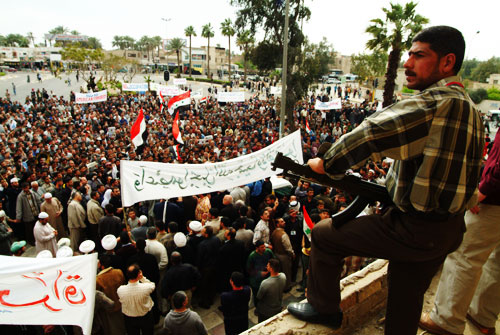
United Press International has interviewed almost a dozen former U.S. diplomats, British scholars and former U.S. intelligence officials to piece together the following account. The CIA declined to comment on the report.

While many have thought that Saddam first became involved with U.S. intelligence agencies at the start of the September 1980 Iran-Iraq war, his first contacts with U.S. officials date back to 1959, when he was part of a CIA-authorized six-man squad tasked with assassinating then Iraqi Prime Minister Gen. Abd al-Karim Qasim.

In July 1958, Qasim had overthrown the Iraqi monarchy in what one former U.S. diplomat, who asked not to be identified, described as "a horrible orgy of bloodshed."

According to current and former U.S. officials, who spoke on condition of anonymity, Iraq was then regarded as a key buffer and strategic asset in the Cold War with the Soviet Union. For example, in the mid-1950s, Iraq was quick to join the anti-Soviet Baghdad Pact which was to defend the region and whose members included Turkey, Britain, Iran and Pakistan.

Little attention was paid to Qasim's bloody and conspiratorial regime until his sudden decision to withdraw from the pact in 1959, an act that "freaked everybody out" according to a former senior U.S. State Department official.

Washington watched in marked dismay as Qasim began to buy arms from the Soviet Union and put his own domestic communists into ministry positions of "real power," according to this official. The domestic instability of the country prompted CIA Director Allan Dulles to say publicly that Iraq was "the most dangerous spot in the world."

In the mid-1980s, Miles Copeland, a veteran CIA operative, told UPI the CIA had enjoyed "close ties" with Qasim's ruling Baath Party, just as it had close connections with the intelligence service of Egyptian leader Gamel Abd Nassar. In a recent public statement, Roger Morris, a former National Security Council staffer in the 1970s, confirmed this claim, saying that the CIA had chosen the authoritarian and anti-communist Baath Party "as its instrument."

According to another former senior State Department official, Saddam, while only in his early 20s, became a part of a U.S. plot to get rid of Qasim. According to this source, Saddam was installed in an apartment in Baghdad on al-Rashid Street directly opposite Qasim's office in Iraq's Ministry of Defense, to observe Qasim's movements.

Adel Darwish, Middle East expert and author of "Unholy Babylon," said the move was done "with full knowledge of the CIA," and that Saddam's CIA handler was an Iraqi dentist working for CIA and Egyptian intelligence. U.S. officials separately confirmed Darwish's account.

Darwish said that Saddam's paymaster was Capt. Abdel Maquid Farid, the assistant military attaché at the Egyptian Embassy who paid for the apartment from his own personal account. Three former senior U.S. officials have confirmed that this is accurate.

The assassination was set for Oct. 7, 1959, but it was completely botched. Accounts differ. One former CIA official said that the 22-year-old Saddam lost his nerve and began firing too soon, killing Qasim's driver and only wounding Qasim in the shoulder and arm. Darwish told UPI that one of the assassins had bullets that did not fit his gun and that another had a hand grenade that got stuck in the lining of his coat.

"It bordered on farce," a former senior U.S. intelligence official said. But Qasim, hiding on the floor of his car, escaped death, and Saddam, whose calf had been grazed by a fellow would-be assassin, escaped to Tikrit, thanks to CIA and Egyptian intelligence agents, several U.S. government officials said.

Saddam then crossed into Syria and was transferred by Egyptian intelligence agents to Beirut, according to Darwish and former senior CIA officials. While Saddam was in Beirut, the CIA paid for Saddam's apartment and put him through a brief training course, former CIA officials said. The agency then helped him get to Cairo, they said.

One former U.S. government official, who knew Saddam at the time, said that even then Saddam "was known as having no class. He was a thug -- a cutthroat."
In Cairo, Saddam was installed in an apartment in the upper class neighborhood of Dukki and spent his time playing dominos in the Indiana Café, watched over by CIA and Egyptian intelligence operatives, according to Darwish and former U.S. intelligence officials.

One former senior U.S. government official said: "In Cairo, I often went to Groppie Café at Emad Eldine Pasha Street, which was very posh, very upper class. Saddam would not have fit in there. The Indiana was your basic dive."

But during this time Saddam was making frequent visits to the American Embassy where CIA specialists such as Miles Copeland and CIA station chief Jim Eichelberger were in residence and knew Saddam, former U.S. intelligence officials said.

Saddam's U.S. handlers even pushed Saddam to get his Egyptian handlers to raise his monthly allowance, a gesture not appreciated by Egyptian officials since they knew of Saddam's American connection, according to Darwish. His assertion was confirmed by former U.S. diplomat in Egypt at the time.

In February 1963 Qasim was killed in a Baath Party coup. Morris claimed recently that the CIA was behind the coup, which was sanctioned by President John F. Kennedy, but a former very senior CIA official strongly denied this.

"We were absolutely stunned. We had guys running around asking what the hell had happened," this official said.

But the agency quickly moved into action. Noting that the Baath Party was hunting down Iraq's communist, the CIA provided the submachine gun-toting Iraqi National Guardsmen with lists of suspected communists who were then jailed, interrogated, and summarily gunned down, according to former U.S. intelligence officials with intimate knowledge of the executions.

Many suspected communists were killed outright, these sources said. Darwish told UPI that the mass killings, presided over by Saddam, took place at Qasr al-Nehayat, literally, the Palace of the End.

A former senior U.S. State Department official told UPI: "We were frankly glad to be rid of them. You ask that they get a fair trial? You have to get kidding. This was serious business."

A former senior CIA official said: "It was a bit like the mysterious killings of Iran's communists just after Ayatollah Khomeini came to power in 1979. All 4,000 of his communists suddenly got killed."

British scholar Con Coughlin, author of "Saddam: King of Terror," quotes Jim Critchfield, then a senior Middle East agency official, as saying the killing of Qasim and the communists was regarded "as a great victory." A former long-time covert U.S. intelligence operative and friend of Critchfield said: "Jim was an old Middle East hand. He wasn't sorry to see the communists go at all. Hey, we were playing for keeps."

Saddam, in the meantime, became head of al-Jihaz a-Khas, the secret intelligence apparatus of the Baath Party.

The CIA/Defense Intelligence Agency relation with Saddam intensified after the start of the Iran-Iraq war in September of 1980. During the war, the CIA regularly sent a team to Saddam to deliver battlefield intelligence obtained from Saudi AWACS surveillance aircraft to aid the effectiveness of Iraq's armed forces, according to a former DIA official, part of a U.S. interagency intelligence group.

This former official said that he personally had signed off on a document that shared U.S. satellite intelligence with both Iraq and Iran in an attempt to produce a military stalemate. "When I signed it, I thought I was losing my mind," the former official told UPI.

A former CIA official said that Saddam had assigned a top team of three senior officers from the Estikhbarat, Iraq's military intelligence, to meet with the Americans.

According to Darwish, the CIA and DIA provided military assistance to Saddam's ferocious February 1988 assault on Iranian positions in the al-Fao peninsula by blinding Iranian radars for three days.

The Saddam-U.S. intelligence alliance of convenience came to an end at 2 a.m. Aug. 2, 1990, when 100,000 Iraqi troops, backed by 300 tanks, invaded its neighbor, Kuwait. America's one-time ally had become its bitterest enemy.
 
Do you know why we didnt find any?

Because we told them to get rid of them or we would kill them.

so they did.Our inspectors found that out well before we ever invaded.

the Bush Crime family...

never met a dictator they didnt like.
 
jerseyart said:
You dont even know your history bor, which is why all you write is so confused.

Let me educate you.

Reagan only began support of Iraq after Iran rejected the UN sponsored peace accord. They also made it clear at that time that they planned on moving past a takeover of Iraq, to claim SA and Kuwait at minimum as well.

It was at that point we "helped" Iraq. Out help consisted primnarily of not objecting to France and Germany (beginning to see a pattern) selling the some 30-40 billion in arms to fight Iran. Our total aid amounted to roughly 1.5 billion (just for comparison purposes) and was largely providing the Iraqis satellite photos of troop movements.


Again, nothing about liberalism that knowledge cant cure
Facts are facts...your boy Ronnie armed them to the teeth.
 
I can't determine which is more pathetic.

The constant pwnage of JA.

JA's lack of debate skills which support nothing he posts.

Or JA posting in regards to "hooked on phonics" with the spelling he possesses.

In any case... carry on.
 
WODIN said:
Facts are facts...your boy Ronnie armed them to the teeth.


Again Ill reference you to the post which you completely ignored in your response.

The French and Germans armed them, and we didnt stand in their way. We did give them satellite info, but Iran was on an expanionist bent (self confessed) and in being supported by the Soviets.

There was a cold war going on bor (by the way you guys were on the wrong side of that one as well) and your side lost ;)
 
jerseyart said:
Cool, thats when we'll be bringing home most of our soldiers as well, since the Iraqis are increasingly able to take over responsibility for their own defense.

That actually deserves its own thread, since it so the evenetuality so completely demolishes the last objection of the left.

Time to make up new excuses to justify your error and your support of a brutal dictator


IOW, Bush will be making a hasty retreat, and will spin it to try to look like an honorable pullout from a job well done.
 
Mr. dB said:
IOW, Bush will be making a hasty retreat, and will spin it to try to look like an honorable pullout from a job well done.


LOL

Dude, you need to catch up on your propoganda. The election is over.


Now terrorism is down, the election is over, democracy is taking hold, and the liberals have moved on to "but at what cost" negativism

The Iraqi forces are already increasingly taking over tasks that were handled by our troops, and the biggest problem appears to be that they arent very good at maintaining the plants we built for them
 
Bushbarians


Spent 1/2 trillion dollars attaching the 2nd largest oil reserves in the world.

Then watched our price for gasoline skyrocket which may very well move us into yet another recession.
 
Sigmund Roid said:
2015....

Jenna Bush is president and starts..... Gulf War III
See I would believe you if you would have said 2012 which coinscides with the Mayan calanders END OF THE WORLD.
 
Top Bottom